1986
Assembler on 8-bit CPUs
My experience with Microsha / RK-86 was one of the first moments when programming stopped being an abstract set of commands and became a real engineering process at the hardware level.
At that time, the personal computer mainly loaded programs and data through magnetic cassette tapes. It was slow, fragile and required patience: a recording error, noise, signal instability or a failed load could force the whole process to start again. This made it very clear how important compact code, reliable solutions and a deep understanding of the computing system really were.
I learned to program the 8-bit RK-86 processor, working with limited memory, processor instructions and resources that now seem extremely small. Every instruction mattered. Every mistake could crash the whole system. Effective solutions required not only knowledge of programming, but also an understanding of computer architecture.
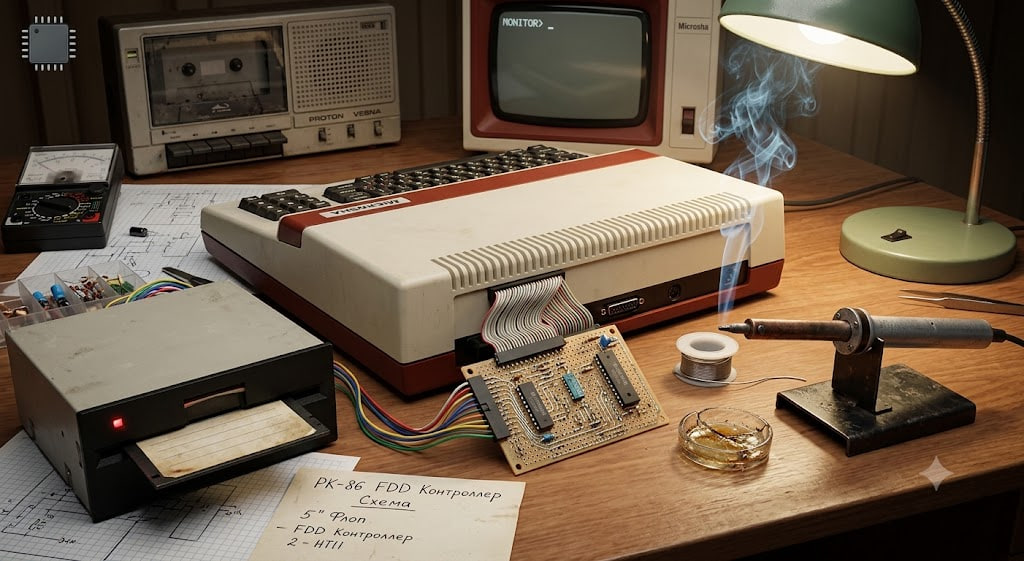
One of the most important practical steps was building a homemade controller for a 5-inch floppy disk drive. I soldered the controller to create a more convenient way to exchange data with a personal computer that was originally designed to load data through cassette tapes. It was not just a learning exercise, but a real engineering upgrade: circuit design, soldering, signal checking, ribbon cable connections, debugging and making different devices work together.
This experience shaped my engineering mindset: understanding memory, processor commands, resource limitations, signals, interfaces and the need to write compact and reliable code. Later, in enterprise systems, telecom infrastructure, Linux administration, Computer Vision and AI agents, the same principle remained: understand the system not only from the top level, but also from the inside.
> This is where my path began — from low-level programming and hardware modifications to modern intelligent systems, RAG, AI agents and robotics.
Key topics: `Microsha`, `RK-86`, `Assembler`, `8-bit CPU`, `Hardware Hacking`, `Floppy Controller`, `Low-level Programming`, `Engineering Thinking`